

Experts in air filtration
Reagent Suppliers
Reagent Suppliers
During the design phase of our flue gas treatment plants, there is a need to define the amount of reagent use:
- DeSOx and HCl abatement using sodium bicarbonate or Lime - bulk bag or silo dosing, silo single or twin discharge, suction and pneumatic conveying
- Dioxins abatement with PAC - small 25kg bag dosing hopper, bulk bag dosing, silo single and twin outputs, with or without ATEX rated components
- DeNOx with urea solution - single or multiple lance, duty or duty standby pumps, IBC urea storage, GRP tank storage
- DeNOx with urea prill - single or multi injection, silo storage or bulk bag, mixing with conditioned water
The amount of consumed reagents affects the plant cost model and is required to direct us to offer a suitable dosing plant system. For instance we offer the following:
- Sodium Bicarbonate or Lime for HCL and SO2 neutralisation (DeSOx)
- Activated Carbon (PAC) for capture of dioxins, furans, heavy metals
- Urea injection for DeNOx (SNCR)
- Hazardous waste disposal of the APC residue
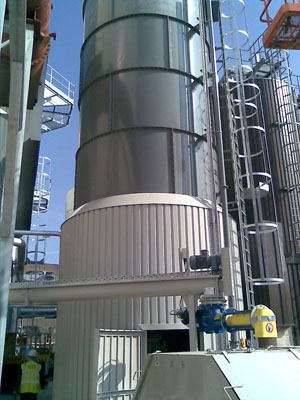
These variations in plant supply give the end user the ability to weigh up a CAPEX vs short or long term OPEX spend. Filter Designs have a program containing the current market rates for reagent supply in all of their forms and can advise on the required plant. Further, we can supply the reagents in all of their forms across the UK at competitive market rates. As FDL can supply the DeNOx and DeSOx plant in addition to the comsumed reagents, we are in a good position to provide accurate advice. In the long term we can add value by monitoring reagent use and maintaining the efficiency of the system, offering advice on new technologies as they arise.
Given NOx, SOx, HCl and gas volume and temperature as inputs, we can advise approximate running costs in a matter of minutes. Of course the efficiency (stoichiometry) of a reagent is dependant on its correct specification and application within the plant.
APC residue from the bag filter can be discharged to a pneumatic conveying line, bulk bag, conditioned for skips, conveyed to a silo or any variation thereof. APC can be disposed of by us efficiently and with all of the prerequisite approvals.
Our recent Projects
An empty warehouse is always a welcome place to start a project. This is because we have a blank canvas with which to design an ideal layout for a flue gas treatment plant. Once installed, our system cleans the gases from a waste boiler and waste infeed plant and will allow the end user to stop transporting waste around the country and manage it locally, save on transport costs and produce some electricity too.
Project VC - Turnkey Flue Gas Treatment Plant for Waste Boiler
Project JP2 - Complete Flue Gas Treatment System for Intumescent Paint Furnaces (Phase 2)
Filter Designs is a trading name of Turnkey Filtration Limited, a limited liability company registered
in England under number 16279255, whose registered office is at Filtration House, Farndon Road, Market Harborough,
LE16 9NP - Website by 1PCS

